

AI Is Amazing. It’s Also Just Another Tool.
There’s a tendency whenever a major new technology arrives to assume that everything that came before it is suddenly obsolete. Right now, that technology is artificial intelligence. Every company needs an AI strategy. Every application needs AI. Every process needs an AI agent. Every software company is suddenly an AI company. AI absolutely deserves the attention. The capabilities emerging from tools like large language models are remarkable, and we’re only beginning to understand what businesses can do with them.
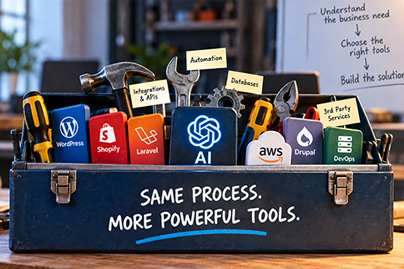
But from a development and business-process perspective, there’s another way to look at what’s happening: We just got some incredibly powerful new tools for the toolbox. And much of the playbook remains exactly the same.
Start With the Business Problem, Not AI
For more than 20 years, our work at Basebuild has generally started with the same question: What is the client trying to accomplish?
Maybe a marketing department is manually transferring leads between systems. Maybe an agency needs information from several platforms combined into a dashboard. Maybe employees spend hours processing documents. Maybe a website needs to communicate with an ERP, CRM or another third-party platform.
We understand the problem first. Then we determine which technologies make sense. That could mean WordPress or Shopify. It could mean Laravel and a custom database. It might require an API integration, an AWS service, a scheduled process, a webhook or an automation platform. And increasingly, it might involve AI.
The process hasn’t fundamentally changed. The toolbox has.
AI Fills a Huge Gap in Automation
Traditional automation is extremely good at predictable tasks. If this happens, do that. When an order is created, send information to another system. Every night at midnight, synchronize these databases. When someone submits this form, create a CRM record and notify the sales team.
APIs, cron jobs, webhooks and workflow automation have been doing things like this for years. The problem has always been the messy stuff in between. Imagine an invoice arriving by email.
Traditional software can detect the email, save the attachment and move the file somewhere. But understanding the document—identifying the vendor, interpreting line items, determining what type of expense it represents and deciding what information matters—historically required either specialized software or a person.
AI changes that. A modern workflow might look something like:
Invoice arrives → application extracts document → AI interprets it → structured data is returned → business rules are applied → accounting API is updated → approval is requested if necessary.
AI handles the fuzzy part exceptionally well. Everything around it is still software development and automation.
Sometimes AI Isn’t the Right Tool
This is also why we shouldn’t try to put AI into everything.
If a business rule says: Invoices over $10,000 require CFO approval, you probably don’t need an AI model deciding whether $12,000 is greater than $10,000. Regular code is faster, cheaper and deterministic.
Likewise, if two applications already have well-designed APIs, connecting those APIs may be all that’s required. The interesting systems are increasingly combinations of technologies.
A solution might use:
Laravel + AWS + a database + OpenAI + APIs + n8n + a human approval step.
Another might simply need:
WordPress + a custom plugin + an API.
The objective isn’t to use the newest technology.
The objective is to solve the business problem using the right combination of tools.
AI Makes Previously Human Tasks Programmable
This is where things really do get exciting. Software has always been excellent at processing structured information. AI dramatically expands the amount of unstructured information software can work with.
Applications can now read documents, interpret natural language, analyze images, summarize information, categorize requests, extract meaning from reports and generate useful responses. Tasks that previously required someone to sit between two automated processes can increasingly become part of the process itself.
That’s a significant development. It means businesses can look again at workflows they previously assumed couldn’t reasonably be automated.
The question becomes:
“Where are people doing repetitive work because the information requires interpretation?”
Those areas are suddenly much more interesting.
Nobody Misses the Boring Work
Automation discussions often drift quickly toward what jobs technology might eliminate. But there’s another side to that conversation. Very few people miss the repetitive tasks technology has already eliminated.
We don’t generally hear employees asking to manually re-enter information that APIs now synchronize automatically. Nobody is campaigning to bring back filing cabinets because cloud databases eliminated filing work.
Technology tends to remove certain tasks while creating entirely new kinds of work. The Web is a great example. Before the 1990s there weren’t meaningful career paths for web developers, SEO specialists, social-media managers, UX designers, eCommerce managers, cloud architects or countless other roles that millions of people now perform.
Entire industries emerged around capabilities that previously didn’t exist. There is every reason to expect AI to produce similar surprises. Some repetitive work will disappear. Existing jobs will change. And new jobs, businesses and opportunities will emerge that are difficult to imagine today.
Same Playbook. Much Better Tools.
AI is genuinely extraordinary technology. We should experiment with it aggressively. Businesses should examine their workflows and ask what is newly possible. Developers should understand how models, agents and AI APIs can fit into the systems they build.
But we also don’t need to throw away everything we already know about building useful software. At Basebuild, the playbook remains pretty familiar:
Understand the business need. Map the process. Identify the bottlenecks. Choose the right tools. Build the solution. Measure whether it works.
Sometimes those tools will be WordPress, Shopify, Laravel, Drupal, AWS or a conventional API. Sometimes they’ll include OpenAI, Claude or another AI platform. Most interestingly, they’ll increasingly be combinations of all of the above. AI hasn’t made good software development or business-process thinking obsolete.
It has simply given us some remarkably shiny new tools—and a much larger universe of problems we can now solve.